A Knight to Remember: The Glory of Y2K "Medievalcore"

Oh my god, we're back again! (Please tell me you get the reference, or I'll really feel old)
We are travelling back to a magical, highly glossed, campy, whimsical era. A time when movie studios looked at the Middle Ages and collectively decided: "You know what this feudal system needs? More crop tops, a synth-pop soundtrack, and characters who look like they belong in a hair commercial."Have you guessed our first official series theme? In my intro post, I promised you autopsy-level breakdowns of how the media absolutely butchers humanity's past for entertainment. Today, we are opening up a cadaver that is near and dear to my millennial heart...Welcome to the launch of The Y2K Medievalcore Revival series!
What is Medievalcore, you might ask?
You might have seen the tag #medievalcore on TikTok, Facebook, Instagram, and the like. It's attached to videos of people in flowy fantasy outfits ready for a Ren Faire, misty forests and castles, and Spotify playlists featuring "Lofi beats to study or joust to". So to understand our terms (I'm still an academic guys, I need to define the terms), we first need to discuss the internet's obsession with turning lifestyles into aesthetics.
We really saw the use of the suffix 'core' in conjunction with the music scene, i.e., hardcore punk in the 80s gave birth to post-hardcore, then metalcore, etc. Around the 2010s, Tumblr users adopted the suffix. They realised they could slap the ending 'core' onto any noun and create an instant subculture. Suddenly, we had normcore (dressing intentionally boring) and cottagecore (the 2020 lockdown obsession with running away to the woods to bake bread). Not surprisingly, the internet saw the Medieval world with its dramatic flickering candles, dramatic cloaks, mysterious misty castles and thought "Yeah, that is a f*cking vibe, let's call it medievalcore". So what is happening here, what does it represent?
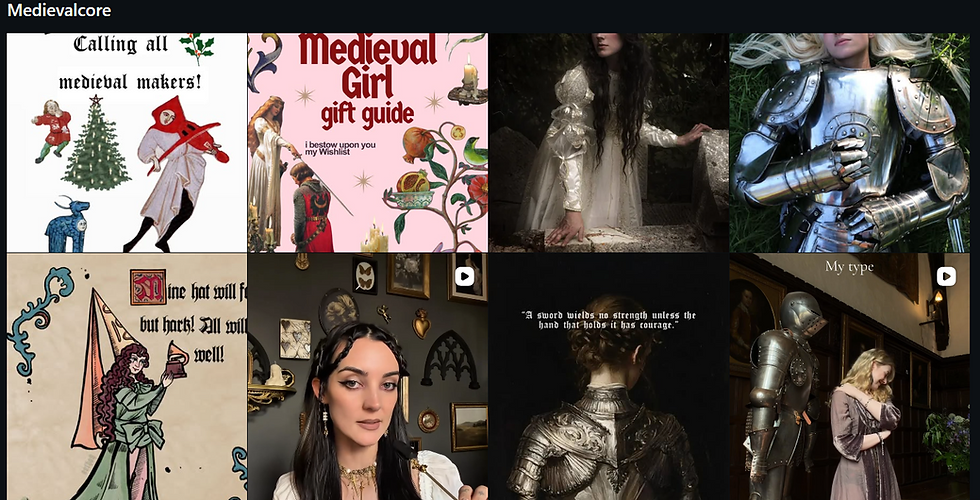
When people romanticise "Medievalcore", they aren't thinking about the literal, nitty-gritty history of the era. Nobody on TikTok is looking for a life without modern dentistry or for a way to hide from a sudden outbreak of the Black Plague. Instead, I think we can see three very specific longings associated with this aesthetic.
Tactile Escapism
We live our lives through glowing, glass screens. For the majority of us, our jobs involve digital components, our entertainment is digital, our friendships are digital, even our existential dread can be strewn out on our digital platforms for all to see. You will be reading this on some form of a screen (maybe I should start a print newsletter). Medievalcore is an aggressive pivot towards the more cosy things you can touch. Heavy cast-iron skillets, warm light from a candle flame, thick carved leather journal covers, cosy knit shawls,etc. It is a more grounding experience to help draw us out of our digital fog and remember the simplistic beauty in the little things around us.
Desire for Intentionality
Today, if a webpage takes more than three seconds to load, we experience minor psychological trauma. We binge entire seasons of shows in a single sitting, and our culture of instant gratification and convenience is slowly destroying our nervous system and attention spans. Capturing a medieval aesthetic is an attempt to mentally opt out of the 24-hour news cycles, the constant ping of notifications, or the doom scrolling on unending content. I think in our modern world, we long for a slower, more intentional style of living.
High Drama Whimsy
Let's be honest, modern clothing can be incredibly boring. Athleisure is great but it doesn't give you that sheer, unadulterated drama of a floor-length cloak swirling behind you in the wind or sleeves you could hide a house in. Medievalcore allows us to feel like we are part of a grand, epic narrative, even if we are just walking to the kitchen to make another iced coffee with oat milk.
This is not a new trend. Every generation creates a version of the past that fixes whatever feels broken in their present, and I think for us today, we want a feeling of some magic; a world that is slow, grounded, and to some degree, romantic because our modern world is entirely too loud, violent, and detached.
So what is the difference between this cosy, slow-living TikTok Medievalcore and Y2K Medievalcore? (This is where you see the boring defining terms part is actually important...clarity, my darlings).
While both pull from the Middle Ages, they are driven by entirely opposite vibes and cultural motivations. If you look at them side by side, the difference is a bit clearer. One is loud, fast-paced, and campy; the other is quiet, slow, and soft.
Y2K Medievalcore | Modern Medievalcore | |
The Vibe | Let's fight a dragon to a Linkin Park soundtrack | Let's read poetry by candlelight while it rains |
Key Aesthetics | Shiny plate armour, sleek leather, campy colours | Heavy wool, misty forests, earthy colours |
The Goals | Blockbuster entertainment | Digital detox and romanticising mundane, slow tasks. |
The Icons | Heath Ledger (A Knight's Tale) and Anne Hathaway (Ella Enchanted) | Sourdough starters, vintage leather-bound journals, fairy lights. |
Roughly spanning from 1998 to 2004, the Y2K era saw filmmakers the medieval world through a Lizzie McGuire filter (take that Hollywood grey filter!). It was a glorious, unhinged, campy aesthetic characterised by amour and dresses you could find at a Spirit Halloween, leather pants that definitely required baby powder to put on, and colour everywhere! Y2K Medievalcore was forged in the fires of pre-millennium optimism and MTV culture. It is maximalist, loud, and stylised. It takes the Middle Ages and pumps it full of adrenaline. If a battle is happening, you're hearing an orchestral score mixed with the early 2000s alt-rock or licensed stadium anthems. It was an intentional clash of modern audio with historically inspired visuals.

Now, here is where my hyper-specific cognitive dissonance kicks in. As an archaeologist, my brain should be melting out of my ears when I watch Heath Ledger ride a horse while the crowd sings "We Will Rock You." But the funny thing about A Knight's Tale (2001) is that from a historiographical standpoint, it actually gets the vibe right. High-stakes medieval jousting tournaments weren't somber, dignified historical reenactments. They were the equivalent of the Super Bowl mixed with a rock concert. The crowd was drunk, people were placing massive bets, and the knights were international rockstar celebrities.
By replacing period-accurate medieval music with classic rock, the filmmakers made the modern audience feel exactly what a 14th-century peasant would have felt entering a tournament arena. It’s anachronistic as hell, but it communicates the psychological reality of the past beautifully. At the end of the day, Medievalcore (Y2K or otherwise) isn't about being historically accurate, and as a historian, I’m giving you permission to enjoy it anyway. It’s a beautifully atmospheric safety blanket for a hyper-connected world.
The Upcoming Autopsy Lineup
Over the next few posts, we are going to perform full reviews on the icons of this era. Here is the official slab schedule:
Movie | Crime Against History | Why We Still Watch It |
A Knight’s Tale (2001) | Nike logos stamped onto hand-forged steel plate armor and perfectly highlighted, beach-waved hair. | It is a flawless cinematic masterpiece and I will fight anyone in the comments who says otherwise. |
Ever After (1998) | Conflating 16th-century Renaissance France with the "Middle Ages," and giving Leonardo da Vinci a side-hustle as a fairy godmother. | Drew Barrymore’s iconic glitter wing moment, and Anjelica Huston absolutely devouring the scenery as the stepmother. |
Shrek (2001) | Turning the feudal landscape into a corporate and Disney-fied theme park (looking at you, Duloc). | It is the undisputed blueprint of anti-fairytale satire, and a Smash Mouth-infused soundtrack that defined a generation. |
Ella Enchanted (2004) | Total, unadulterated plastic medieval consumerism, complete with a literal medieval shopping mall. | Anne Hathaway singing "Somebody to Love" to a herd of giants. |
Grab your popcorn, dust off your old low-rise jeans, and get ready. Next, we kick off with the king of the castle: Heath Ledger and the glorious rock-and-roll stadium culture of 14th-century jousting in A Knight's Tale.
Which of these four fever dreams is the ultimate king of Y2K Medievalcore? Let me know in the comments!

Comments